



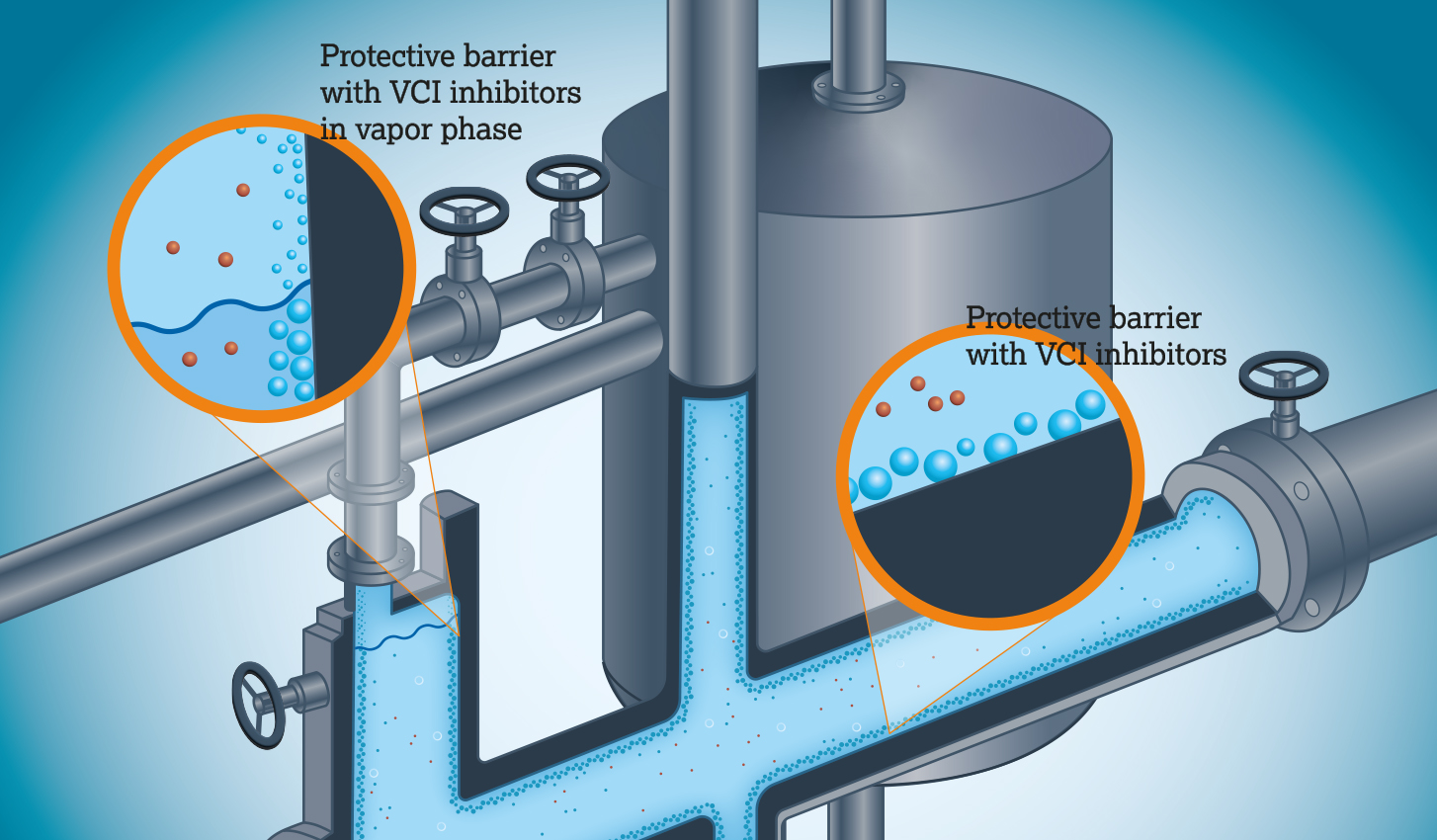
In industry, hidden spaces in complex pipework and tanks are often the most vulnerable - and by far the most difficult to protect. Traditional corrosion inhibitors rarely reach all the way into the bends, threads or tops of pipes, leaving these areas vulnerable to condensation and corrosion.
An anti-corrosion additive with Volatile Corrosion Inhibitors (VCI) technology enables comprehensive protection via a unique two-step process that secures the entire system, not just the fluid-affected parts.
Intelligent protection in two phases
When a modern VCI additive, such as Cortec 649 BD, is added to a cooling or water system, two unique defence mechanisms are activated:
In the liquid phase (Adsorption): The inhibitor molecules seek out all metal surfaces that the liquid touches. Through molecular attraction, they form an extremely dense, invisible protective layer. This layer acts as an electrochemical barrier, effectively ”switching off” the reactions that cause rust.
In the vapour phase (Passivation): This is where the real strength lies. The inhibitor releases protective vapours that fill the void above the liquid surface. The vapours condense on all inaccessible metal surfaces, creating active protection where the liquid cannot reach.
Self-healing and prevention
Unlike a passive oil film, VCI protection is self-healing. If the surface is damaged or scratched, there are always inhibitors left in the system that immediately rush to the site to repair the protective film. Advanced additives like Cortec 649-BD also help to keep the pH of the fluid stable and prevent scale build-up. This protects the system against both corrosion and clogging.
Depending on the conditions of your system, VCI technology is available in different bases. While Cortec 649 BD is optimised for water and glycol systems, offering products that M-529 and M-531 corresponding high-performance VCI protection as an additive in oil and lubricant systems.
The result? A safe and cost-effective solution that extends the life of your equipment and eliminates the need for complicated hidden space inspections.


