

What is VCI corrosion protection (VpCI)® – how does it work?
How VpCI® works
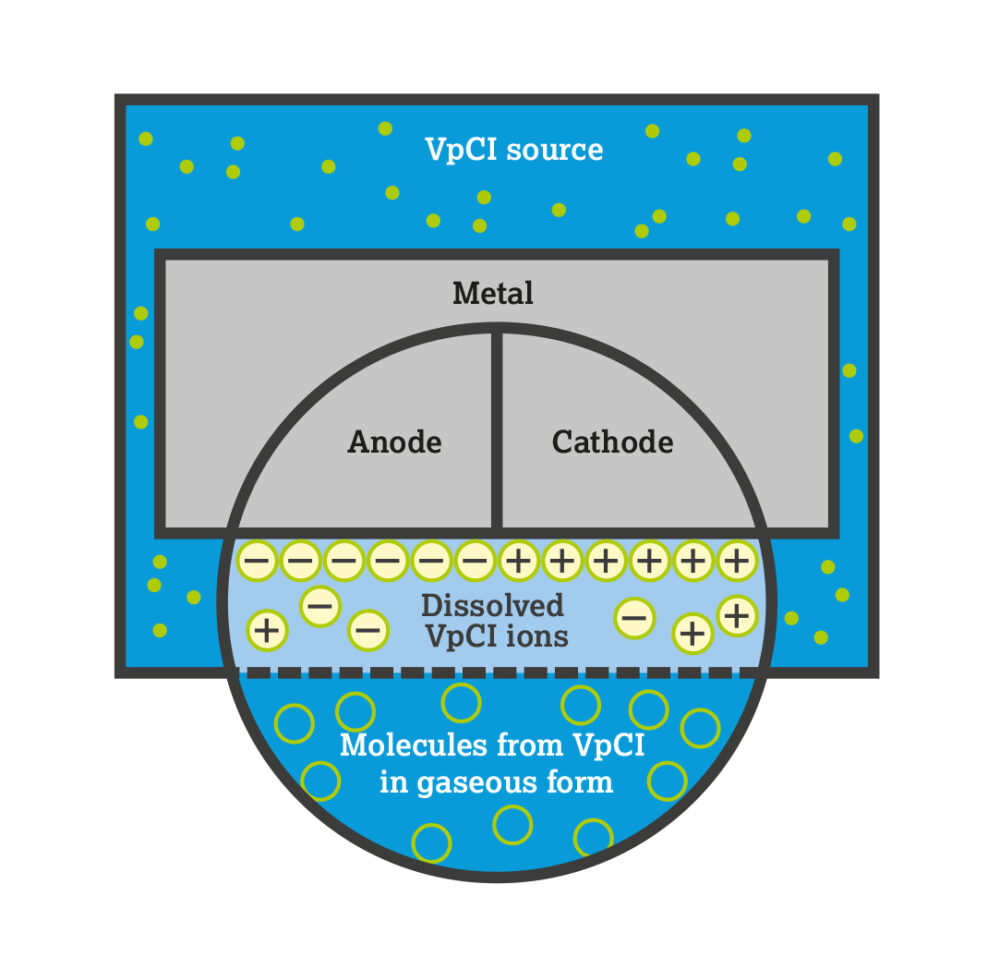
VpCI® inhibitor is transported via a vapour phase to all surfaces of the metal to be protected. As long as there is enough inhibitor in the vapour phase around the metal to maintain a condensed phase on the surface, adequate protection is achieved.
The vapour phase acts only as a transport aid from the source to the metal surface where it builds up a molecule-thick layer of protection and thus stops the attack. All surfaces, including cracks, crevices and other inaccessible areas, are fully protected by VpCI®.


Dry rustproofing - here's how it works
The products to be protected are placed in a VCI (VpCI), such as a bag. When the bag is sealed, an active process starts that gives you comprehensive corrosion protection down to the smallest porosity, for as long as you want. Previous time-consuming and sometimes even harmful methods, such as greasing or oiling components, become a thing of the past. With our dry VCI corrosion protection, you promote a better working environment and climate, while saving time and resources.
Read more in our fact sheet on dry rust inhibitors.
Liquid corrosion protection - here's how it works
The products to be protected need to be dipped, sprayed or brushed with a liquid VCI (VpCI) product, such as a water-based VCI rust inhibitor. Once the liquid is on the surface, an active process starts that gives you comprehensive rust protection down to the smallest porosity, as long as the product remains on the surface. Previous time-consuming and sometimes even harmful methods, such as lubricating components with grease or oil, become a thing of the past. Tribotec's liquid VCI technology favours the working environment.
Read more in our fact sheet on liquid rust inhibitors.


Shortest readyness time
When unpacking, the benefits become even more tangible. No decontamination work is needed, the components can go directly to the assembly or machine park and be unpacked, installed and commissioned in record time. The time savings are as impressive as the cost savings.
Short and long term cover
We have solutions for you whether you need temporary protection in factories, longer-term protection for shipping and storage, or long-term protection for stored parts in varying environments and weather conditions.
Welcome to contact us for more information!
How does it work?
To understand how vci corrosion inhibitors work, we start by looking at the definition of corrosion inhibitor.
The definition of a corrosion inhibitor according to the (NACE) National Association of Corrosion Engineers is a substance that inhibits corrosion when added to the environment in small concentrations. A corrosion inhibitor fulfils one or more of the following functions:
- By adsorption as a thin film on the surface of the corroding material
- By inducing a thick corrosion surface
- By creating a passive surface on the metal surface
- By changing the environment or by producing precipitates, removing or disabling aggressive media.
Unlike protective coatings and desiccants, the VCI corrosion protection method provides both active and passive protection. The chemical corrosion process is immediately affected by vapour phase and contact phase inhibitors.
VpCI® stands for vapour phase inhibitor and is a registered trademark of Cortec® Corporation to make it clear that Cortec®VCI has true vapour phase protection and not just contact protection as most VCI products have.
Cortec VCI corrosion protection (VpCI®) is a cost-effective method that provides multi-metal protection (protection for ferrous and non-ferrous metals in one product).