



Silicone Gap Pads, flexible heat management for electronics
Gap Pads for thermal management in electronics are soft and mouldable silicone-based materials used to fill spaces between a hot component, such as a processor or chip, and a heat sink. They act as a thermal bridge that conducts heat away from the component.
Contact us for more information and assistance with our customised Gap Pads solutions.

Gap Pads for thermal management in electronics are soft and mouldable silicone-based materials used to fill spaces between a hot component, such as a processor or chip, and a heat sink. They act as a thermal bridge that conducts heat away from the component. We provide Gap Pads in different thicknesses and sizes and offer customised solutions as required.
Key facts about Gap Pads:
- Thermally conductive and electrically insulating
- Soft and elastic
- Used for high component tolerances and gap dimensions in the range 0.5 to 5.0 mm
- Various polymer bases possible, silicone-containing and silicone-free
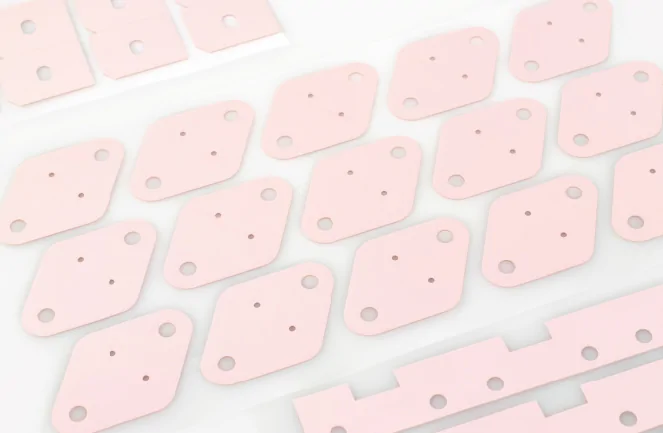
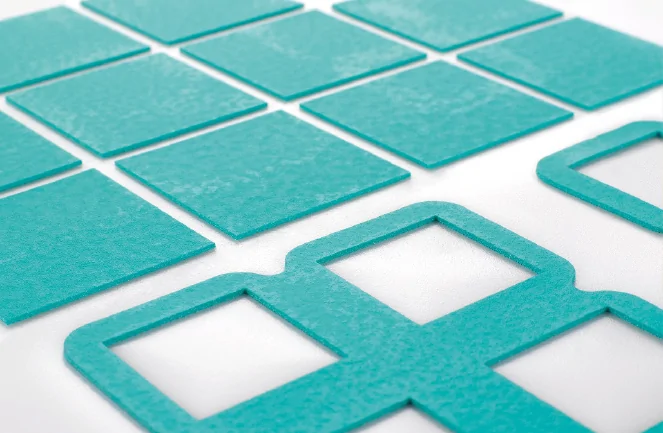
- Available as standard sheets and as specifically cut sizes
- Easy handling and good mechanical strength
How are Gap Pads fitted?
We offer Gap Pads, which are moulded as required using various cutting and punching systems. The systems required for this are selected based on many years of experience depending on the application and quantity. There are also different options for the delivery mould. Punching residues can be removed on request and various covering films can be used. Cover and carrier films are used to protect the product from dust and dirt and must be removed on site before the product is applied to the electronic component or heat sink. Gap Pads are then easily removed from the carrier film, simplifying the manual application step.
To facilitate and ensure positioning, most Gap Pads are lightly self-adhesive, preventing them from slipping after application. For fully automatic application, a pick and place system can be used.


